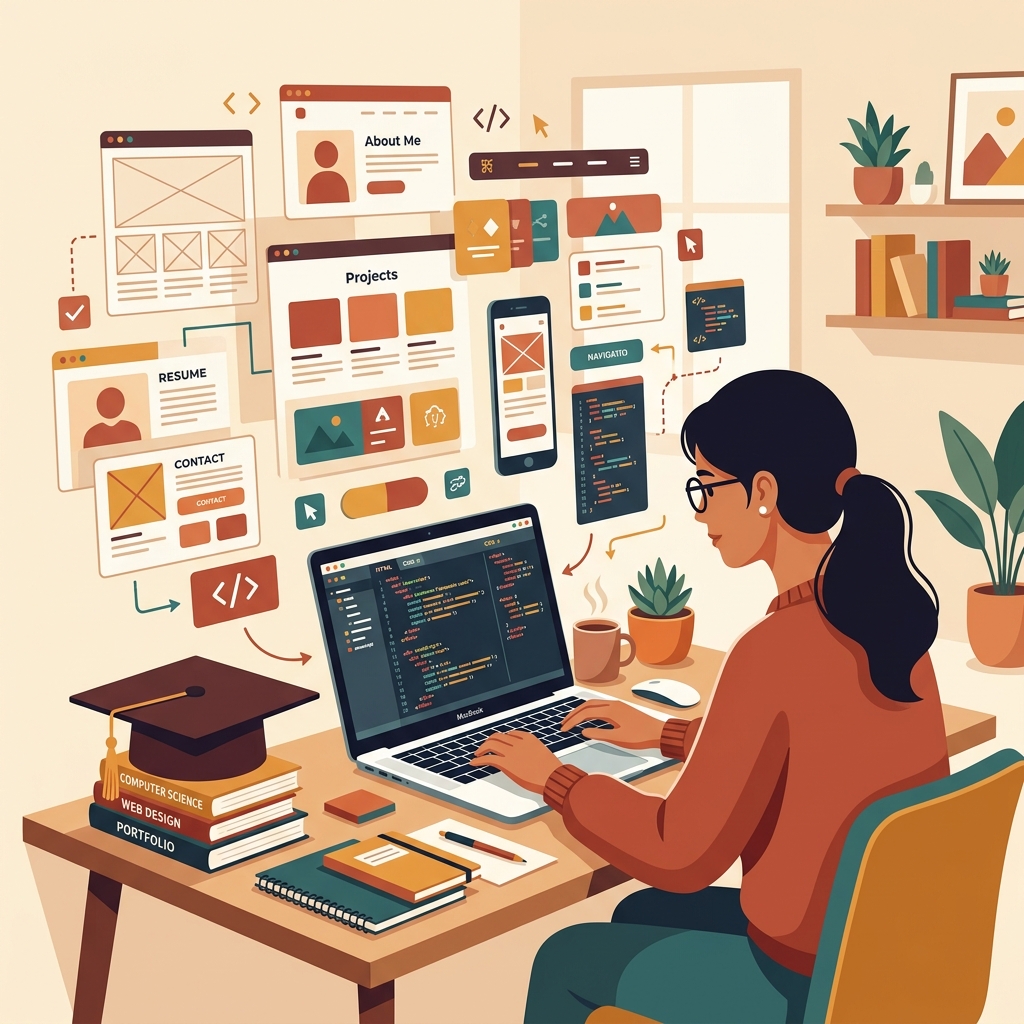
Why Every BCA Student Needs a Portfolio Website
As a BCA (Bachelor of Computer Applications) student, you're learning programming, web development, and software engineering fundamentals. But here's the truth most colleges don't teach — your degree alone won't land you a job. What will? A portfolio website that proves you can actually build things.
I'm Himanshi Agarwal, a BCA student from Pratap Nagar, Jaipur, and building my portfolio website was one of the best decisions I made during my degree. In this article, I'll share exactly how you can build a standout BCA student portfolio that impresses recruiters and opens doors.
What to Include in Your BCA Student Portfolio
1. A Strong Hero Section
Your portfolio's first impression matters. Include your name, a clear title like "Aspiring Software Developer", and a brief description of what you do. Recruiters spend only 6 seconds scanning — make those seconds count.
2. About Me Section
Share your story as a BCA student. Talk about your interests in programming, the languages you're learning (Python, Java, HTML, CSS), and what excites you about technology. Be authentic — recruiters appreciate genuine passion.
3. Technical Skills
List your skills clearly. For most BCA students, this includes:
- Programming Languages: Python, Java, C
- Web Technologies: HTML5, CSS3, Responsive Design
- Tools: Microsoft Excel, VS Code, Git basics
- Concepts: OOP, Data Structures, Problem Solving
4. Real Projects
This is the most important section. Don't just list your college assignments — build real projects that demonstrate your skills. For example:
- A menu-based banking system in Java (shows OOP skills)
- A personal portfolio website built with HTML & CSS (shows web dev skills)
- Python automation scripts (shows practical problem-solving)
5. Contact Information
Make it easy for recruiters to reach you. Include your email, location, and links to your LinkedIn or GitHub profile.
Technical Tips for Building Your Portfolio
Start with HTML & CSS
You don't need React or complex frameworks. A clean, responsive portfolio website built with semantic HTML5 and modern CSS3 is more impressive than a template-based site. It proves you understand the fundamentals.
Make It Responsive
Over 60% of web traffic comes from mobile devices. Use CSS media queries and flexible layouts to ensure your portfolio looks great on all screen sizes. This is a skill recruiters specifically look for in front-end developers.
Optimize for SEO
Add proper meta tags, descriptive titles, and structured content so your portfolio appears in Google searches for terms like "BCA student portfolio", "fresher developer Jaipur", and "aspiring software developer India".
Common Mistakes BCA Students Make
- Using templates: Build from scratch to prove your skills
- No real projects: College assignments aren't enough — build something unique
- Poor design: Invest time in clean typography, spacing, and color
- No mobile support: Always test on phones and tablets
- Missing contact info: Make it easy for people to reach you
My Experience Building This Portfolio
When I started building my personal portfolio, I had basic knowledge of HTML and CSS. I spent time learning about responsive design, CSS Grid, Flexbox, and modern web aesthetics. The result is the website you're reading this on — built entirely from scratch, no frameworks, no templates.
If you're a BCA student looking to stand out, start building your portfolio today. You don't need to know everything — start with what you know and improve as you learn. Check out my projects section to see what's possible with basic HTML & CSS skills.
Want to see a live example? Check out my portfolio →